Your feed could come with the algorithm switched off. The government won't go that far.
A National Press Club address called for curated feeds to be off until users switch them on. The government is only considering letting people opt out.
The algorithm that decides what you see could be switched off by default.
Not the app. The recommendation engine inside it.
That was the proposal put to the National Press Club on Wednesday by Chanel Contos, the campaigner whose petition put consent education into the national curriculum.
Under it the default feed runs in chronological order and carries only the accounts you follow, and explore pages serve a broad national average instead of material shaped by your own scrolling.
Anyone who wants the personalised version turns it on.
It is the 2016 internet, restored by law.
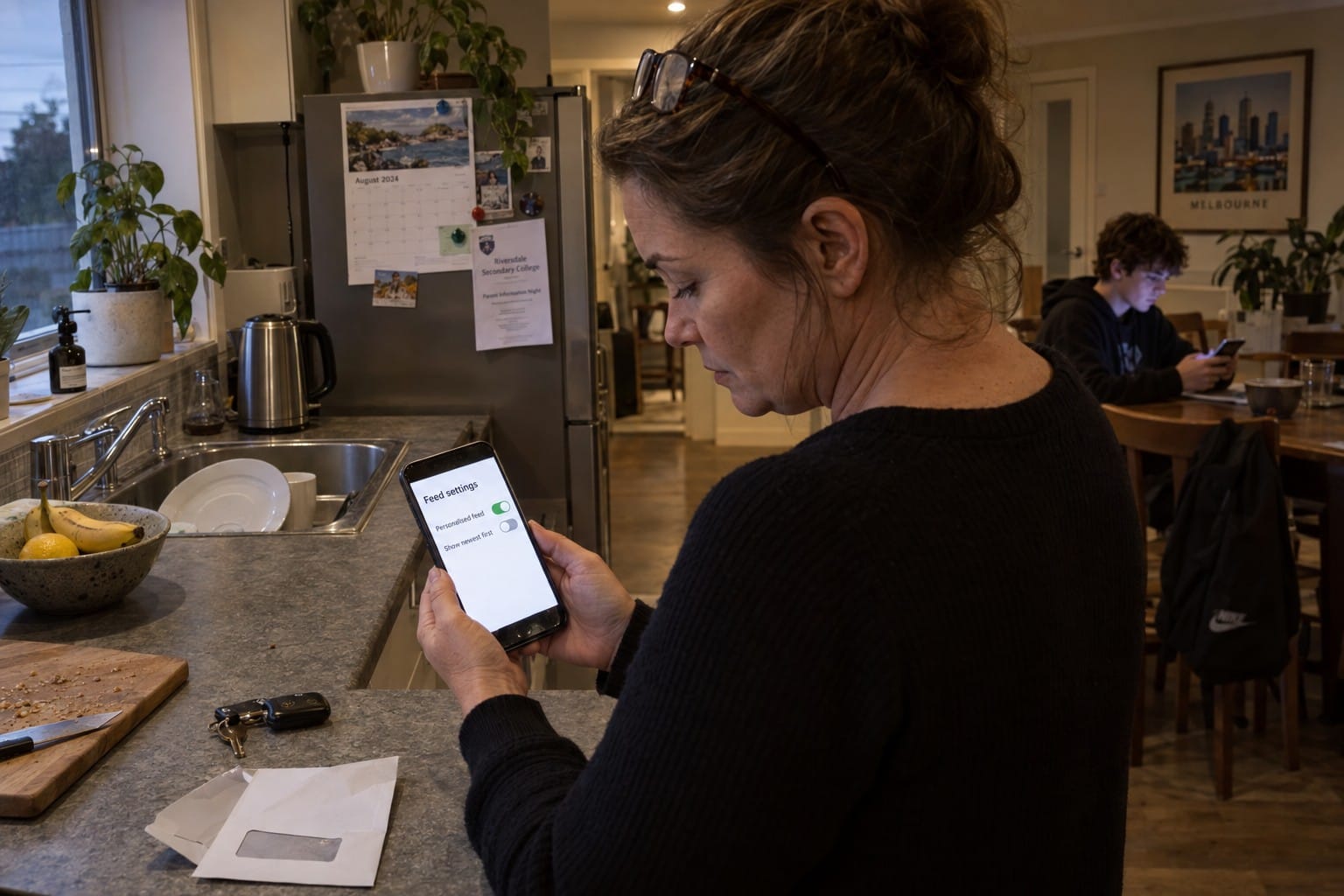
The government is not offering that.
It is looking at an opt-out, where the algorithm stays on by default and you can go and turn it off, Social Services Minister Tanya Plibersek has said.
Anthony Albanese has backed giving people more control over what they receive on their devices without going near opt-in.
The gap between those two words is the entire fight.
Defaults are the product. Almost nobody changes them, which is why an opt-out that ships with the feed already running is a settings menu rather than a reform.
"It is too easy for big tech to design schemes that appear as structural reform but actually suit them just fine," Contos said.
The framing is deliberate.
Australia rewrote its consent laws so that silence is not agreement and the answer has to be yes. The feed still runs on the old rule.
"Opt-in algorithms would fundamentally make the transition onto social media for 16-year-olds and other children safer, and it would bring the principle of affirmative consent to our screens," she said.
The evidence read out is Melbourne's.
The Man Box research, by Jesuit Social Services, found men who most strongly held rigid ideas about manhood were 17 times more likely to have hit a partner, eight times more likely to have thoughts of suicide nearly every day and twice as likely to binge drink.
Boys aged 16 to 18 are served misogynistic content within 25 minutes of signing up, the press club was told.
The government's own ministers keep making the case for it.
Communications Minister Anika Wells has called recommender systems "deliberately opaque".
Education Minister Jason Clare was blunter this week.
"The bad guys here are the big tech companies, they're the ones poisoning our kids with algorithms that are shovelling shit into their heads," he said.
None of it has produced an opt-in.
An exposure draft of Labor's digital duty of care, which would oblige platforms to find and reduce foreseeable harm rather than wait for users to report it, is due this month.
The under-16 ban settled who gets an account. Nobody has settled what the account is allowed to do to them once they have one.