What to expect from Albo’s national AI speech today
The Prime Minister is expected to announce a new Office of AI inside his own department today, as Labor stays deadlocked over whether to trade copyright for data centres.
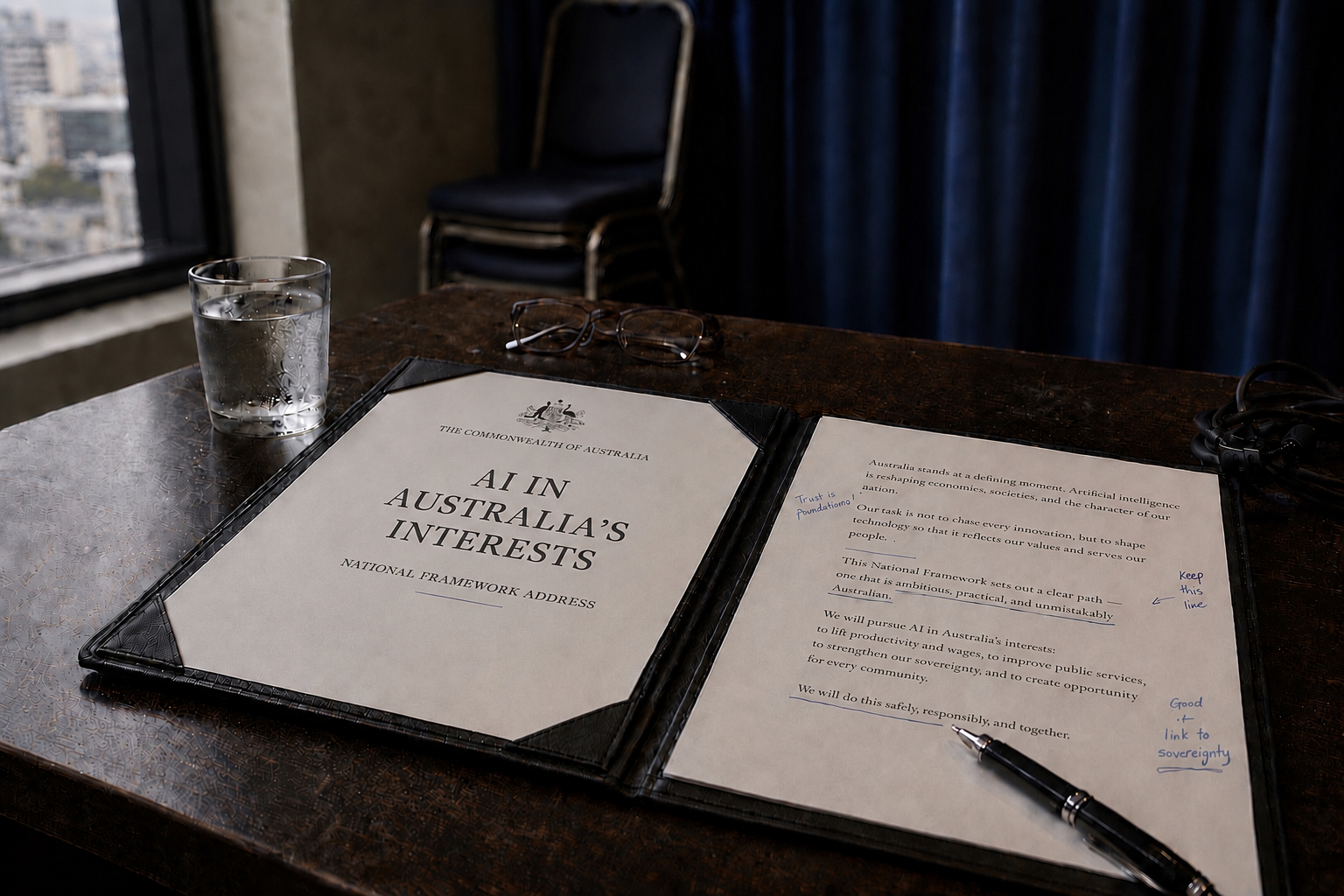
Anthony Albanese is expected to announce a new Office of AI this afternoon, run out of his own department, in an address at the University of Sydney titled “AI in Australia’s Interests.”
It sits inside the Department of Prime Minister and Cabinet — not Industry, not the Attorney-General’s, not anywhere it might be argued with.
Excerpts released ahead of delivery have him arguing AI touches every minister and department, and that an issue-by-issue response is no longer enough — the way government built coordinated approaches to civil aviation in the 1920s and genetics in the 1990s.
He is expected to claim a world first: the first country to bring these issues into a single national framework.
The pitch to investors is in the excerpts too — greater clarity and speed for approvals, a streamlined process for verifying compliance.
Read that again.
The world-first framework is being sold, in the same breath, as a faster approvals process.
Defence is in there. The excerpts point to the 2026 National Defence Strategy, which identified AI as holding the most significant potential for technological disruption in coming years. He is expected to say extremists and state actors already use AI to create propaganda aimed at young people, and to spread disinformation targeting democracies.
The frontbench gets a name-check. Chris Bowen on energy. Jim Chalmers on productivity. Amanda Rishworth with unions and employers. Michelle Rowland consulting on copyright. Jason Clare meets his state counterparts today on AI in schools, where student-made deepfakes have already forced eSafety interventions.
What it will not cover is the fight splitting the government.
Guardian Australia has been told the address will be more vision statement than policy. No copyright announcement is expected.
Consider what has been signed while that fight stays unresolved.
Microsoft committed $25 billion in April. Amazon has pledged $20 billion. OpenAI has $7 billion in a near-complete NextDC facility at Eastern Creek, pitched as sovereign infrastructure for sensitive government workloads on the strength of Australia’s place in the Five Eyes intelligence alliance. Google is weighing $20 billion. Blackstone paid $24 billion for AirTrunk before any of it.
Then there is Anthropic.
Anthropic chief executive Dario Amodei flew into Canberra in late March, met Mr Albanese and Mr Chalmers, and signed a memorandum of understanding under the National AI Plan. It covers data centres, workforce data and safety collaboration. It carries no enforceable obligations and no penalties. It does not mention copyright.
He was not expected to meet Ms Rowland, whose department holds it.
The company is now in advanced talks for at least 1.4 gigawatts of Australian data centre capacity — roughly the size of the entire existing local industry — in a deal reported at around $21.6 billion. Tenders went to CDC, AirTrunk, Iren and NextDC. Decisions are expected within weeks.
It is also the company the AFR reported was pushing for a copyright deal.
Labor ruled out a text and data mining exception last October, rejecting a Productivity Commission proposal to let developers train on Australian works without permission or payment.
Then in late June, a whistleblower tipped off independent senator David Pocock: an industry push for a copyright carve-out in exchange for at least $50bn in data centres and a creators’ fund worth around $350m a year.
Mr Pocock called it the “ultimate dirty deal.”
“To sell out Australian creatives for a couple of hundred billion dollars in datacentres, a bump to GDP, would be reckless,” he told the Senate on July 1.
Industry Minister Tim Ayres accused him of “reckless speculation.”
Anthropic now says it sought clarification on copyright settings, not an exemption — while telling government its investment depends on policy certainty.
The split runs through cabinet. Mr Ayres and Andrew Charlton are keenest on courting AI money. Ms Rowland, who holds copyright, and Arts Minister Tony Burke want to protect creatives.
The Coalition’s response was that the office is three years too late.
Ed Husic, dumped to the backbench after wanting a dedicated AI Act, is saying the quiet part.
“We’re being pressured by US tech that if we don’t sign up to these datacentre deals now, we’ll miss out,” Mr Husic says. “Impulse purchases are often regretted.”
Australia is the second-largest destination for data centre investment after the US — propping up an otherwise mediocre rate of GDP growth.
That is the leverage. It is also the trap.
Mr Albanese’s invitation promised a plan that “boosts our sovereign capability.”
Sovereign capability is a strange phrase for a government that has spent the year signing MOUs with American labs.
A new office in PM&C does not change that.
It just means that when the answer comes, there will be no one else to blame for it.