Trump cut the US childhood vaccine list from 18 shots to 11. Australian vaccination has already fallen five years in a row.
About 80,000 Australian children are not up to date, and what parents now report is not cost or appointments but distress.
Donald Trump has cut the list of vaccinations recommended for American children from 18 to 11.
Hepatitis B is now only recommended for babies at high risk.
The measles, mumps and rubella shot has been split across three appointments instead of one.
Australia recommends 15 and none of that has changed here.
It does not need to.
"Anything Trump says filters through to Australia," University of Sydney vaccination researcher Julie Leask told the Guardian.
"Australian parents and caregivers hear it, and it does affect a minority of people and makes them wonder about vaccines and their safety."
Hepatitis Australia watched search traffic for a year.
Every time the US government questioned a vaccine, Australians went looking online.
"The results that they get are often wrong," chief executive Lucy Clynes said. "They're very scary."
The results those parents find were not written in Washington.
They are written by the accounts that turned themselves into virologists in 2020, built an audience on lockdowns and never gave it back.
The pandemic ended. The channel did not.
Doctors are now having to argue with it.
The Australasian Society for Infectious Diseases has had to tell parents the measles shot is safe and there is no reason to change how Australian children get it.
It attached 10 studies.
That is a professional body defending settled science against volume.
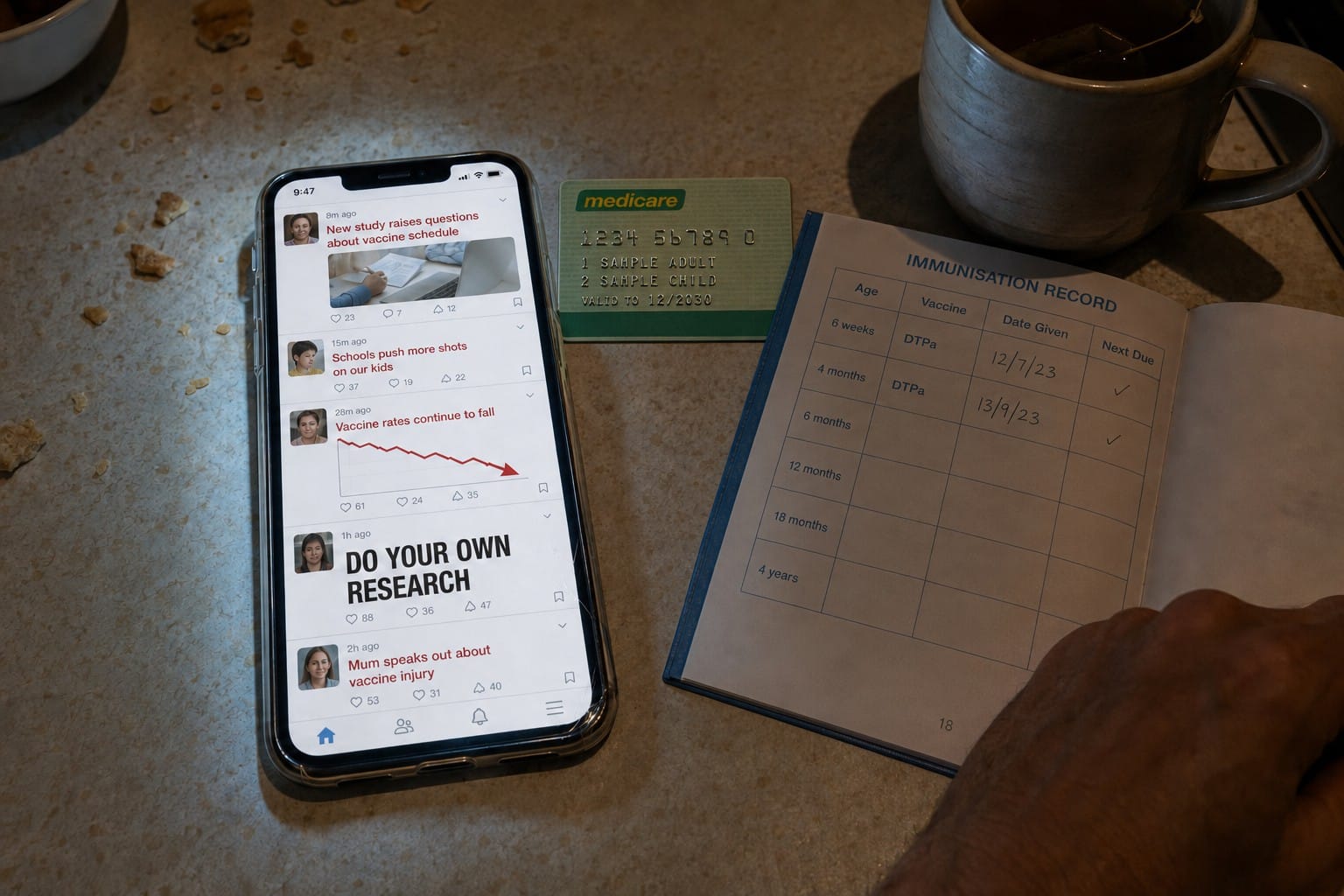
Here is what it has cost.
Childhood vaccination in Australia has fallen five years in a row.
About 80,000 children are not up to date.
Measles cases have gone from none in 2021 to 168 last year, and this year is running ahead of that.
Two babies have died of whooping cough in the past two years.
Before that there had not been a death in about a decade.
Five years ago, 56 in every 100 parts of the country hit the level of coverage that stops an outbreak.
Now it is 18.
The falls are steepest in the places that were already lowest.
A national survey of parents published in February found what changed.
Cost held steady. Getting an appointment held steady.
What collapsed was belief.
The most common thing parents said was that vaccinating their child now distressed them.
Among parents whose children were behind, more than half thought vaccines were unsafe.
Among parents whose children were up to date, it was one in 20.
Half did not trust their own doctor.
Leask warns against the easy version of this argument.
Parents do not swallow whatever crosses their feed, and their worries are often reasonable.
The most effective misinformation, she says, is partly made of facts.
She is right.
It does not get the cookers off the hook.
Nobody has to believe the conspiracy for it to work.
They only have to walk into a doctor's room carrying a feeling.
That feeling is the product, and it has been in production since 2020.
Two babies. Ten years. That is the bill.