The machine police use copies your whole phone, including what you deleted. Nobody publishes how often it runs.
Cellebrite is already used by police in six Australian jurisdictions, and no agency reports how many devices it has emptied.
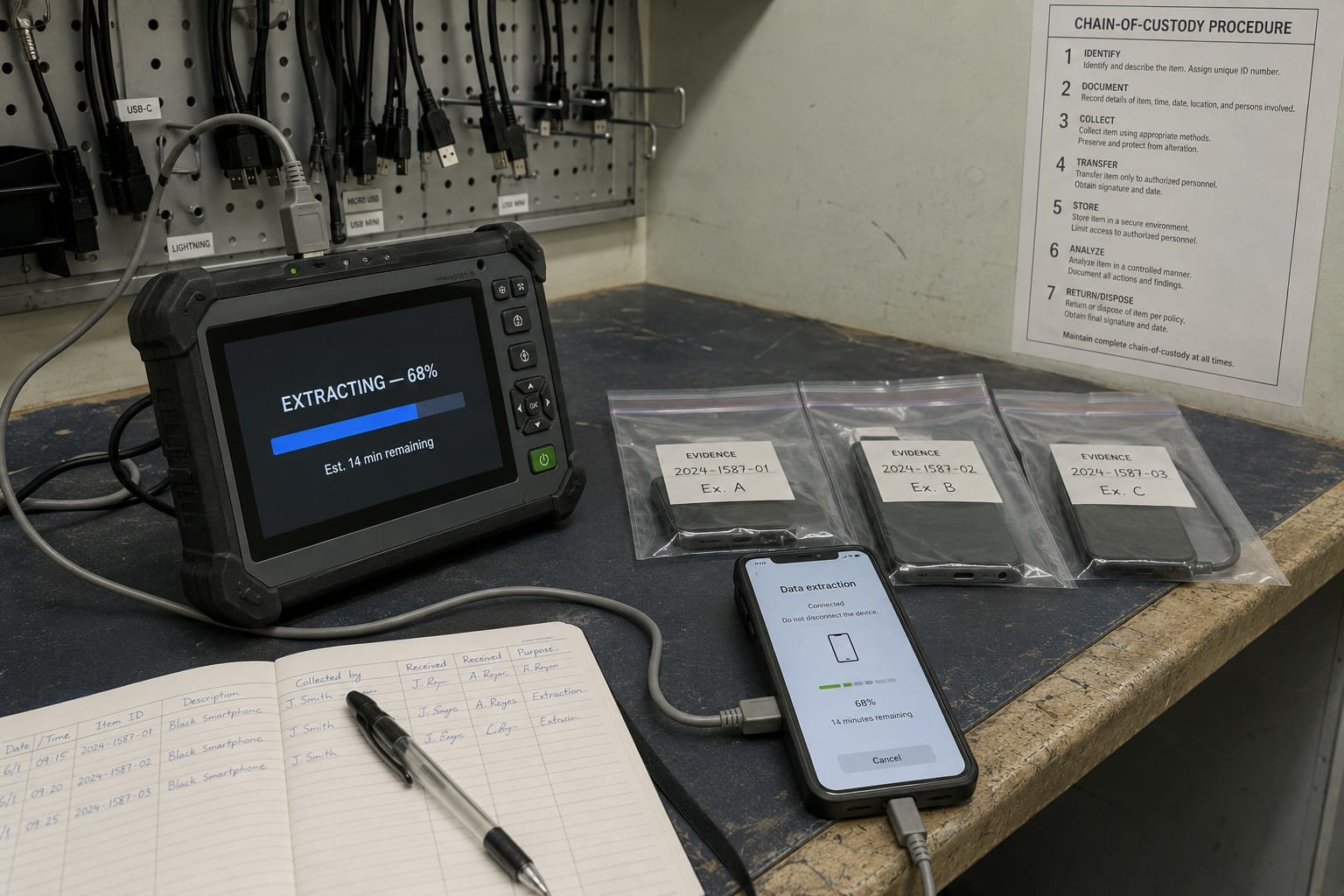
Plug a phone into a Cellebrite Universal Forensic Extraction Device and it copies the whole thing.
Every message, including the ones sent through WhatsApp, Signal and Telegram.
Every photo, every search, call logs, contacts, health data, location history, metadata and biometrics.
Deleted material comes back too, because deleting on a phone marks the space as reusable rather than wiping it.
The operator does not scroll through the device.
It is emptied in one operation and the copy is theirs.
Cellebrite was founded in Israel in 1999 and is listed on the Nasdaq.
Its own website says the research and development group behind the product is built from former members of top Israeli intelligence units, and that the technology has been bought by 6,900 agencies and enterprises in more than 100 countries.
Its products are already used by police in Victoria, Queensland, Western Australia, South Australia, the ACT and the Northern Territory.
Federally, Greens senator David Shoebridge says the company holds 128 active Commonwealth contracts worth more than $15 million, across Defence, the Australian Federal Police, the Australian Taxation Office, Services Australia and others.
What changes the picture is not the technology.
It is when police are allowed to use it.
A bill introduced in New South Wales on August 6 would let officers compel someone to unlock a phone at an arrest, at a roadside stop, or during any other lawful detention.
Until now that order could only be sought where a device had been seized under a search or crime scene warrant.
Refusing is an offence, and the bill says self-incrimination is not a reasonable excuse.
The order can be made against a person police believe has knowledge of an organised crime offence.
Not a suspect. Knowledge.
Nothing in the bill requires the copy to ever be deleted.
The regime has existed in New South Wales since February 2023 and not one number has ever been published.
The police annual report does not count the orders, and the Crime Commission says it does not publish the figure.
Nobody outside the agencies knows how many phones have been emptied, or where the copies are.
The company's record is the other half of it.
Myanmar police used Cellebrite to open the phones of Reuters reporters Wa Lone and Kyaw Soe Oo, who were investigating the Rohingya massacre.
Both were jailed for seven years.
Serbian police unlocked a journalist's and an activist's phones with it and then installed spyware, according to Amnesty International.
Jordanian authorities extracted data from at least seven activists detained over speech critical of the war in Gaza, Citizen Lab found in January.
The American Friends Service Committee has documented the Israeli military using it on the phones of thousands of detained Palestinians.
Cellebrite has announced withdrawals from Russia, China, Myanmar and Serbia.
The equipment kept working.
The Intercept found Chinese police still buying after the exit, and Forbes and TechCrunch reported in June that Russian authorities used the tools on a dissident's iPhone after the cutoff.
In New South Wales, Police Minister Yasmin Catley told parliament in March that the force does not, and never has, engaged Cellebrite to facilitate digital surveillance.
NSW Police use Cellebrite. The contracts are commercial-in-confidence and the spending cannot be disclosed for the same reason.
The denial holds only if extracting a person's entire digital life at the side of a road is not surveillance.