One Nation supporters are sharing anti-Muslim posts written in Indonesia by accounts with headscarves in the profile picture.
Meta pays those accounts by the click, and suspended seven of the 14 groups the Guardian identified only after the money had gone out.
The largest pro-One Nation pages on Australian Facebook are not run by One Nation supporters.
They are run out of Indonesia, Vietnam and the Philippines by people being paid to make Australians angry.
One page A Current Affair examined has 117,000 members and three administrators, all in Indonesia.
Another was six weeks old.
Its account had spent years posting about food and daily life in South Sumatra before switching to Australian politics.
A third had been posting videos about fruit trees.
The Guardian went through 14 of the biggest pro-One Nation groups in June.
Each had at least 8,000 members. Most were created this year.
The administrators were tagged as digital creators and offered subscriptions, which is Facebook's way of saying they get paid.
Meta's content monetisation programme paid about US$3 billion to an estimated 16.2 million accounts last year.
That is the whole mechanism. Not ideology. Piece rates.
The content works because it is built to work.
ABC News Verify pulled a week of posts from 14 of these accounts in March and found 370 images.
Pauline Hanson was in 191 of them.
Fake charity. Fake cancer. Fake confrontations she won. Breaking news that never broke.
"It's incredibly easy on social media just to make you really angry about something," political communications expert Ed Coper told A Current Affair.
"Your gut instinct when you see something that's rage bait is to immediately engage with it, and so people know they just have to make something that'll make you really angry and they'll get all the engagement."
Which is the part One Nation supporters cannot solve by being angrier about it.
The anger is the product. Every share of an outrage post about Muslims or migrants or Labor pays a stranger in Palembang who does not care which way the reader votes.
Some of the accounts posting anti-Muslim material carry profile pictures of women in headscarves.
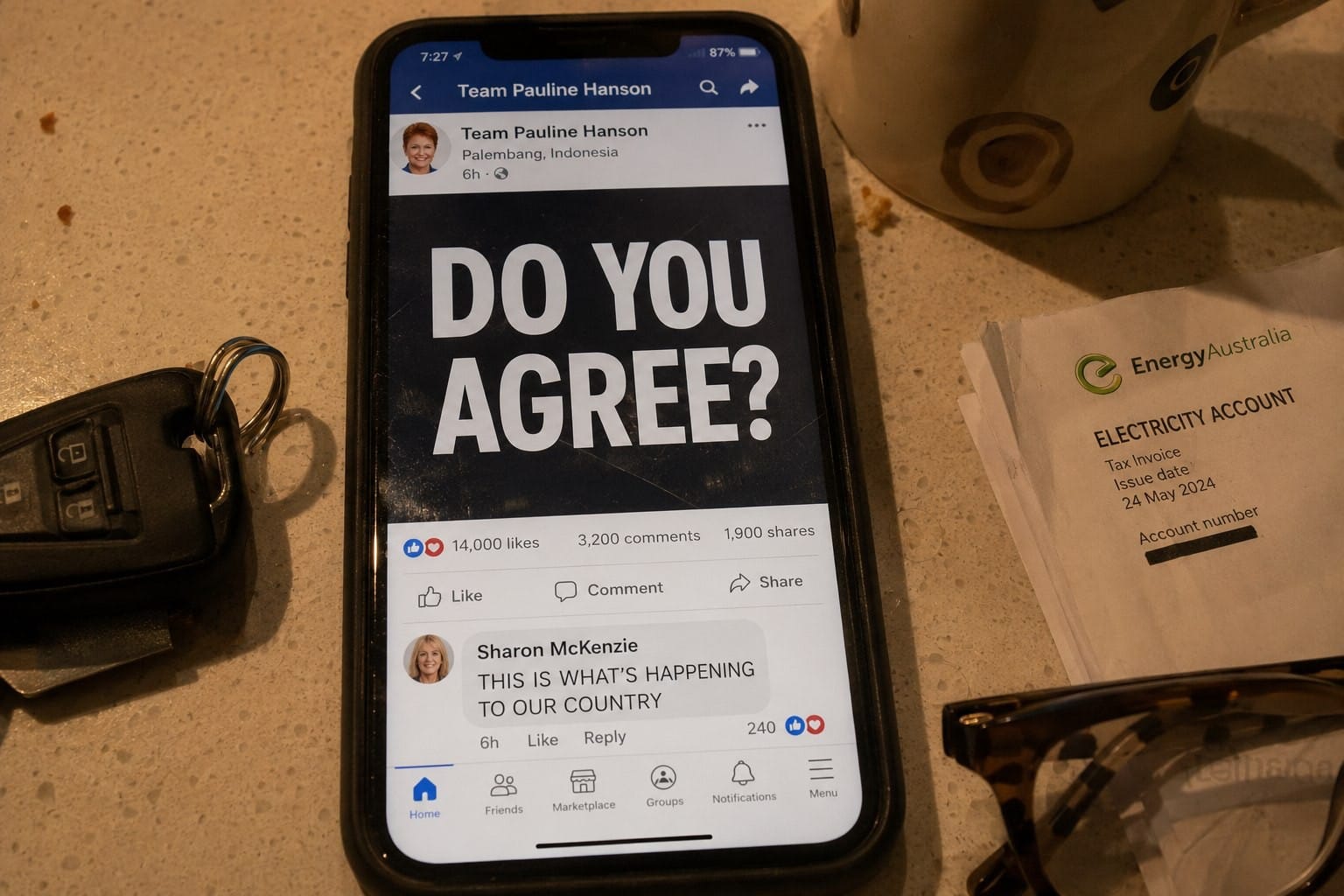
One post seen by A Current Affair still had the instructions attached, telling the poster to ask the audience a question.
ANU researcher Ross Tapsell, who has spent a decade studying disinformation in Southeast Asia, says the region has an established influence-operations industry.
Its workers are called buzzers. They are hired in teams, run accounts they have built for years, and often never meet the people paying them.
One person can run 15 pages and post the same image to all of them, which is why the same images turn up across dozens of Australian groups.
Shown the evidence, One Nation called it deliberate foreign interference and denied any connection to it.
The party that has spent 30 years warning about foreigners is now describing its own online support base in the language it usually saves for immigration.
Greens senator Sarah Hanson-Young has called for an investigation.
Meta suspended seven of the 14 groups the Guardian identified.
Half. After the engagement, and after the money.
Communications Minister Anika Wells has no plans to legislate.