One Nation barred the ABC, The Age and the Guardian from its Victorian launch, the third time it has locked reporters out this year
Pauline Hanson is running the sequence Donald Trump used on the White House press corps, in a country with no constitutional protection for the press.
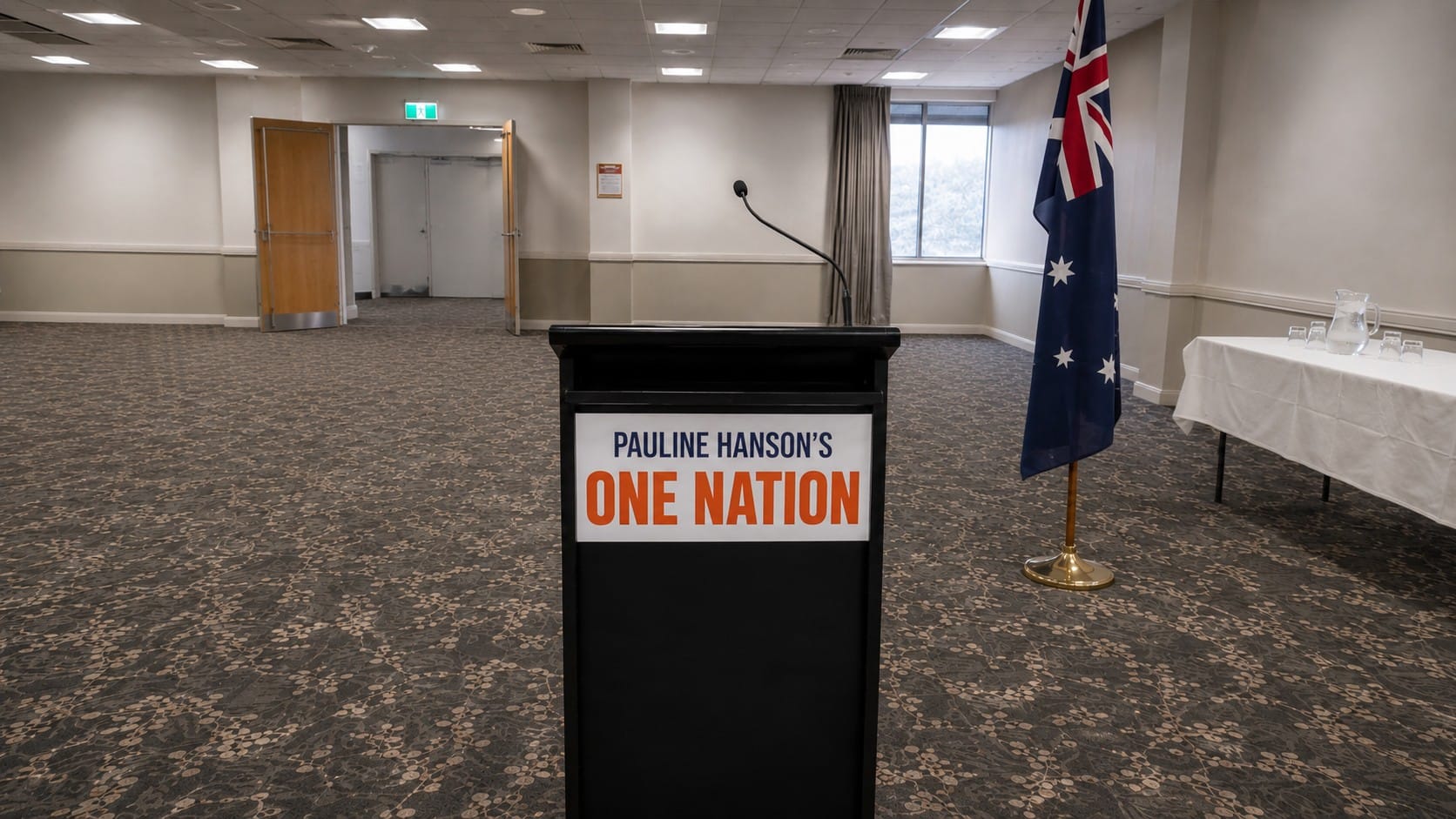
Pauline Hanson announced One Nation's Victorian leader and seven upper house candidates in Melbourne on Monday, in a room she had emptied of the ABC, The Age and Guardian Australia.
“I want truth and honesty,” she told the reporters who remained.
“You get it from me. I expect it back from the media.”
New state leader Warren Pickering said the party was open to scrutiny but would take “swift legal action” against character assassination.
Asked why voters were getting fewer than four months to examine a party contesting every lower house seat, Pickering said One Nation needed to “play to every strategic advantage we've got”.
It is the third time this year.
On the eve of the Farrer byelection in May, party staff removed an ABC journalist from a press conference — Hanson later said that one shouldn't have happened.
In June, at the National Press Club, she called Guardian political correspondent Sarah Martin a “trashy journalist” and banned her from all future press conferences.
Martin had asked why One Nation was appointing and paying Hanson's daughter, Lee Hanson.
In between, at a press conference in Adelaide, a staffer told a Guardian journalist to shut up and Hanson was heard calling her a nasty bitch.
One Nation's candidate at the Nepean byelection refused to speak to the ABC at all.
The journalists' union condemned it.
So did the International Federation of Journalists.
Nothing changed.
The Age is simply the newest name on the list.
Australians have already seen where this leads, from an Australian journalist.
In September last year the ABC's Americas editor John Lyons asked Donald Trump on the White House lawn whether it was appropriate for a sitting president to be doing so much business.
“Oh, the Australian — you're hurting Australia,” Trump said.
“In my opinion, you are hurting Australia very much right now, and they want to get along with me. You know, your leader is coming over to see me very soon. I'm going to tell him about you. You set a very bad tone.”
When Lyons tried to follow up, Trump said: “Quiet.”
An official White House account then posted that the president had smacked down “a rude foreign Fake News loser”.
Days later the ABC was barred from Trump's press conference in the United Kingdom.
That is the same mechanism Hanson used on Sarah Martin.
Ask the question, lose the room.
The rest of the American sequence is on the record.
In February 2025 the White House barred the Associated Press from the Oval Office and Air Force One for writing Gulf of Mexico.
A fortnight later it took control of the press pool from the White House Correspondents' Association, which had run it since 1914, and created a “new media” seat that gets the first question and mostly goes to right-wing outlets.
In October the Pentagon demanded reporters sign new rules to keep their passes, and almost every outlet refused, including Fox News.
In November Trump called for ABC News to lose its broadcast licence because a reporter asked about Epstein.
The Associated Press sued and won at first instance.
Judge Trevor McFadden, a Trump appointee, wrote that a government which opens its doors to some journalists cannot shut them to others over their viewpoints.
Then an appeals court paused that ruling while the government appealed, and the ban went back on.
That is what Trump was celebrating when he posted: “Big WIN over AP today.”
That case existed because of the First Amendment.
Australia has no equivalent, and no remedy for an outlet locked out of a press conference.
It is not only One Nation — Anthony Albanese's staff barred Pacific journalists from a press conference in the Solomon Islands last year.
But One Nation is polling 19 per cent in Victoria and 31 per cent nationally, and it is not asking to sit on the crossbench.
It is asking to govern, and it has already shown what it does with a room.