Kids are quitting office jobs for the trades because AI got there first. The trades are not hiring either.
The job they were meant to learn on is being done by software, and the trade they are running to has been shrinking for years.
Toby Blooranta was headed for accounting or finance.
He is now an apprentice installing heating and air conditioning.
"You can't find an AI that's going to run a cable for you or, you know, unclog a toilet," he told 7NEWS.
His university friends are still looking for work.
He is not an outlier.
A survey of 200 young Australians by the jobs platform Work180 found 69 per cent are at least moderately worried about what AI does to their prospects, 58 per cent say it has already changed a career decision, and half the students in it are thinking about switching fields.
Two hundred people is a small sample.
The reasoning behind it is not.
"The entry level market is shrinking particularly for white collar roles," Work180 chief executive Gemma Lloyd said.
"AI is doing all of the tasks that our young people used to learn from."
That is the actual problem, and it is worse than a hiring freeze.
The graduate job was never mainly about the work.
It was the place you learned to do the work — the filing, the checking, the first draft somebody senior pulled apart.
Software does all of that now, faster and without a salary.
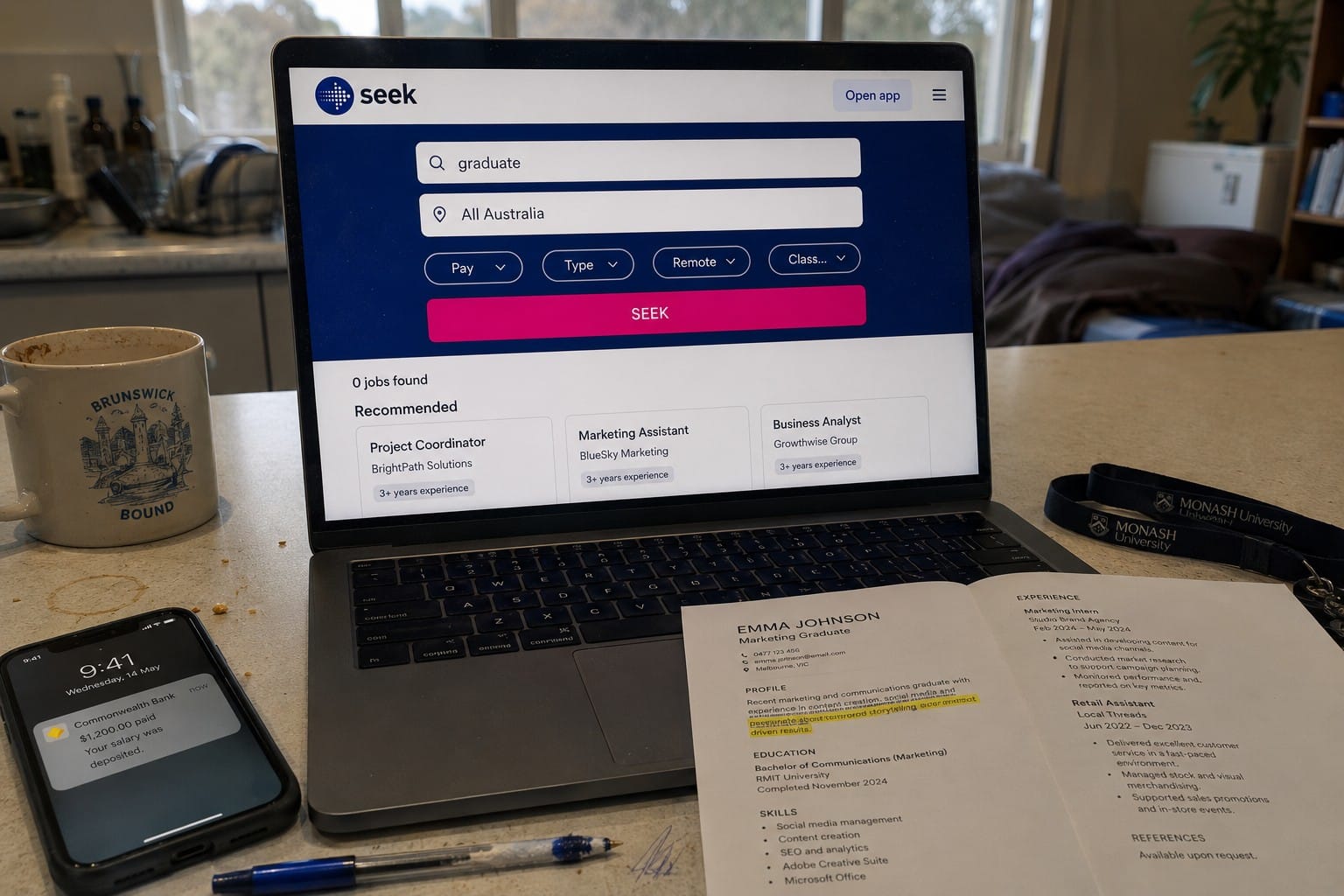
So the ladder is intact from the second rung up, and the first rung is gone.
Blooranta's answer is the obvious one.
Pick something a machine cannot physically do.
Except the trades are not the open door they look like from outside.
Trade apprenticeship commencements fell 15.3 per cent in the year to June 2025, according to the National Centre for Vocational Education Research.
Every state and territory except the Northern Territory went backwards.
The numbers have since turned up — trade starts rose 12.5 per cent in the December quarter — but the Australian Industry Group says the longer trend has not.
"A clear structural decline in commencements has been underway for several years," chief executive Innes Willox said in July, after the federal budget withdrew $266 million in support for employers of apprentices.
The people already in it are doing better than they were.
Of the trade apprentices who started in 2019, 58.7 per cent finished inside six years, and the rate has risen for every intake since 2015.
Getting in is the part that has closed up.
Work180 has launched something called the Early Careers Coalition, asking employers to commit to a million jobs for young people by 2032 and to promise they will not automate those roles away.
It is a voluntary pledge with no penalty attached.
A generation has worked out that the bottom of the office has been automated and gone looking for a trade instead.
Nobody has told them the bottom of that has been shutting too, and for longer.