Fitness apps never sold you the workout and AI just exposed it
StrongLifts and MyFitnessPal alone cost nearly $700 a year on monthly billing. One prompt rebuilt them both, plus Couch to 5K.
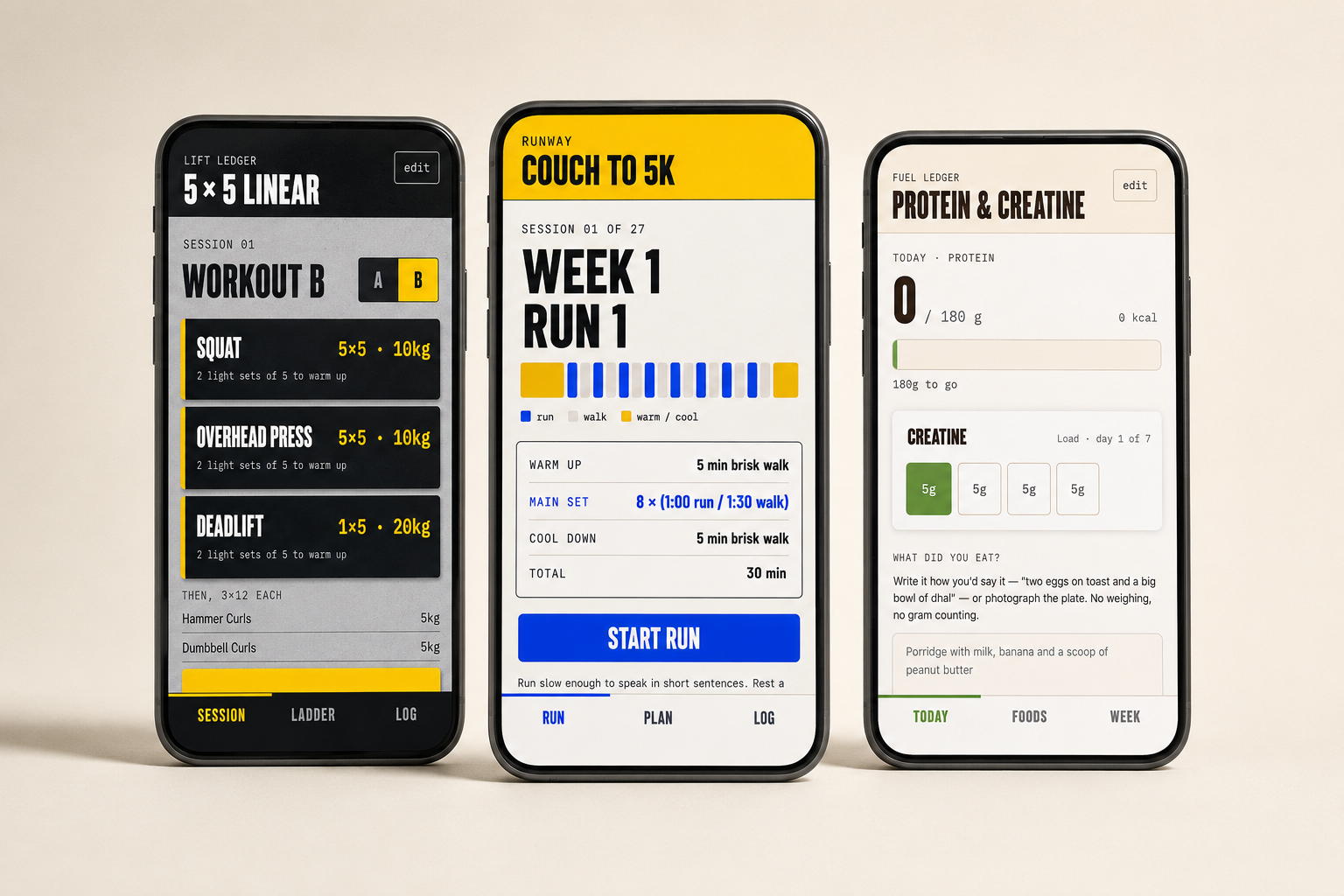
I asked Claude to rebuild StrongLifts 5×5, Couch to 5K and MyFitnessPal.
One prompt.
It came back with all three — the lifting programme, the running programme, and a tracker that reads photographs of my meals and estimates the calories.
No subscription. No trial. No app store.
Here is what those apps normally cost.
StrongLifts is free to download and then useless until you pay: $89.99 a year, or $17.99 a month if you don't commit up front, which works out at $215.88.
MyFitnessPal's top plan is $39.99 a month, or $479.88 a year.
C25K, the official Couch to 5K app, is free to start and then puts its features behind a subscription of its own.
Nearly $700 for two of them, before you even get to the third.
Now consider what you are actually buying.
The 5×5 lifting routine is more than 70 years old, credited to Reg Park, Bill Starr and Glenn Pendlay long before anyone thought to put a paywall around it.
Couch to 5K was written by Josh Clark in 1996 to get his mother off the couch, and he published it on the web for nothing.
Britain's NHS turned it into a free app downloaded more than seven million times.
That app has never been available in Australia.
Here you pay someone else for the same nine weeks — and the name itself is now a registered trademark.
None of these companies invented the programme.
What they sell is the wrapper — the timer, the progression maths, the tick in the box.
That was a very good business right up until the moment a chatbot could assemble the same thing in a minute, shaped around the equipment you actually have.
The industry can see it coming.
The AI personal trainer market was valued at $16.9 billion last year and is forecast to reach $65.7 billion by 2033.
MyFitnessPal itself bought the photo-calorie app Cal AI in March.
Everyone is racing to sell you the AI version of a thing you can now just ask for.
The catch is the calories.
Photo estimation is the flashiest part of the setup and the least reliable — independent testing puts typical error between 15 and 25 per cent, and one benchmark measured portion accuracy as low as 39 per cent.
Useful as a rough daily read. Useless as a precise number.
Which is about where the human survives.
No model watches your hips shift under a loaded bar, or notices when you have quietly stopped turning up.
Everything else is now a prompt.