Canada wouldn't sign a trade deal, so Trump renamed their lake "Lake America"
He announced it in the Oval Office beside a hand-lettered cardboard sign, and said the Atlantic and the Pacific might be next.
Donald Trump has signed an executive order renaming Lake Ontario.
It is now Lake America, as far as the United States government is concerned.
The order instructs Interior Secretary Doug Burgum to change the name in the Geographic Names Information System and strip every reference to Lake Ontario from federal maps, contracts and documents.
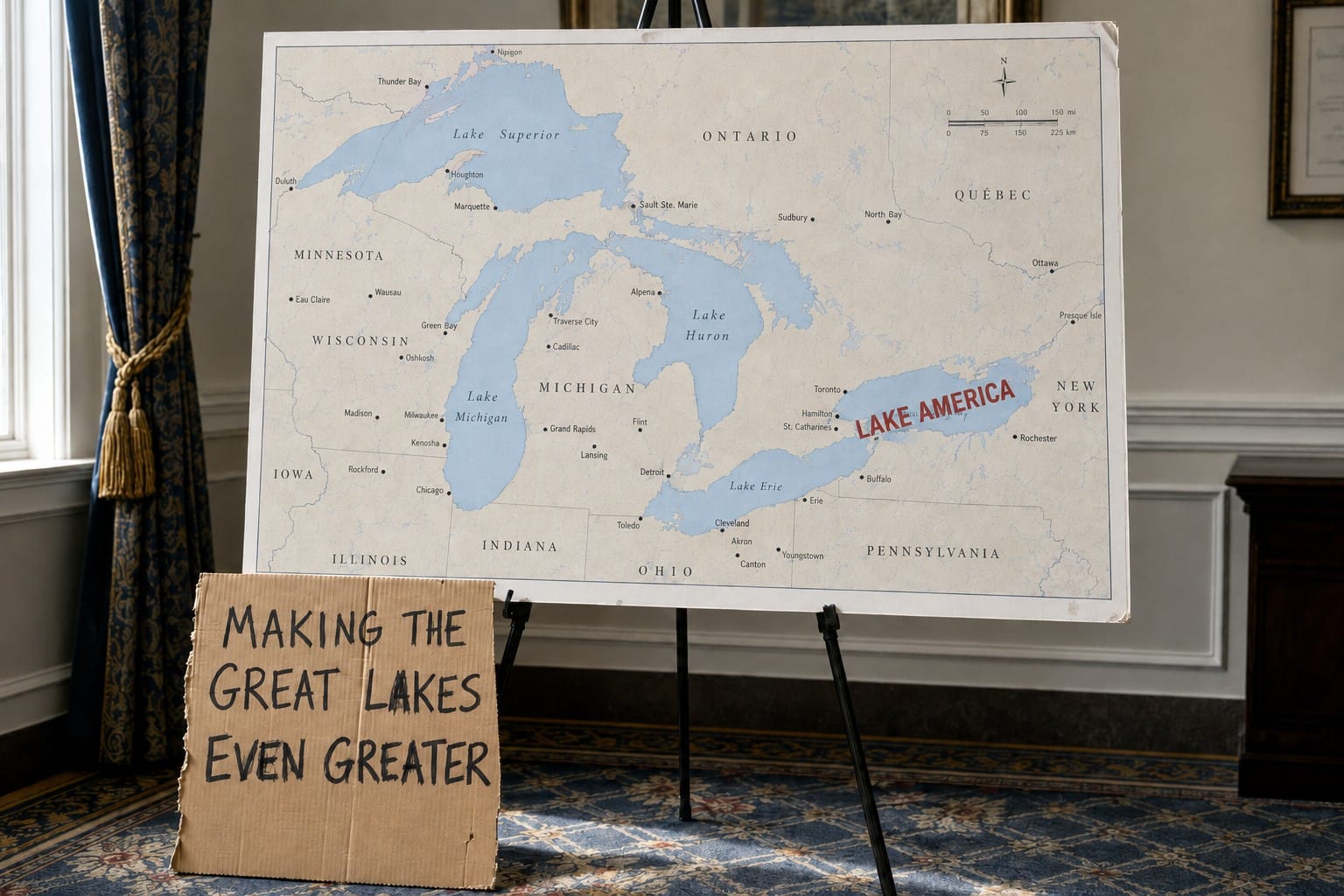
He announced it in the Oval Office beside an enlarged map with Lake America stamped across it in red, and a cardboard sign reading "Making the Great Lakes Even Greater".
The reason is a trade war.
Talks collapsed on Friday night, hours before a midnight deadline, after what Prime Minister Mark Carney called last-minute American demands that were unfair and uneconomic.
He suspended negotiations and recalled Canada's negotiators from Washington.
Fifty per cent American tariffs took effect just after midnight on Saturday, hitting about US$20 billion of Canadian goods including wine, furniture, dairy, cement, clothing and hockey equipment.
Canada will match them dollar for dollar from September 8, targeting American steel, dairy, appliances, agricultural equipment, pulp and paper and electronics.
"You're at war when you get attacked. We got attacked," Mr Carney said.
"Canada has been ripping us off for a long time on trade, very sadly," Mr Trump said.
"They don't pay us to defend Canada, but we defend Canada. They don't pay for anything. But they want to be treated like they're a state. We just can't do that any more."
White House staff secretary Ben Moss offered the technical case.
Most of the lake's volume sits in the United States, and the deepest parts are in American territory.
Ontario is the single largest export destination for more than a dozen American states.
Mr Trump then went further.
"We have a gulf, and we have a lake. Now all we need is an ocean," he said. "So, maybe we'll have to change the name of the Atlantic and/or the Pacific. Maybe we'll change them both."
Canada is not required to adopt any of it, and has given no sign it will.
Mr Carney pointed out that the name comes from the Wendat word Ontari'io, meaning the lake is beautiful, the lake is big.
"The name is more than 400 years old, predating both the Confederation of Canada and the Declaration of Independence of the United States of America," he wrote.
"We know that America is changing. Their trading relationships, their foreign policies, their national monuments, their hydronyms."
"Canadians also know that naming reality means calling it Lake Ontario, then, now and always."
Ontario Premier Doug Ford said it is Lake Ontario to Canadians and the rest of the world, now and forever.
Brampton mayor Patrick Brown called the renaming preposterous.
"We're still going to call it Lake Ontario, I think many of you will still call it Lake Ontario," he told CNN.
"The only person who is going to have a trouble with what to call it is your President."
There is no single international body that decides the names of shared bodies of water.
Which means the practical effect of the order is that American federal documents will use one name and everybody else will use the other.
The Gulf of Mexico went the same way in Mr Trump's first months back in office.
Google Maps now shows it as the Gulf of America to American users.
The tariffs are still 50 per cent in both directions.