Albanese says training AI on Australian art without permission is theft. He didn't announce a law against it.
The Prime Minister promised to legislate data centre rules his government already published in March, while copyright reform got one line and no timeline.
Anthony Albanese stood up in Sydney on Wednesday and called it theft.
"No company should use Australian books, music, art, or news to build or train AI without the artist's control," the Prime Minister said. "Anything less is theft."
It was the hardest line he has delivered on the subject.
He did not announce a law against it.
What he announced was an Office of AI inside his own department, a set of Australian Standards for large data centres, and a promise to take the package to National Cabinet next month. Legislation early in 2027.
Seven months ago his government said it wouldn't do this. The National AI Plan, released in December, ruled out a standalone AI act and mandatory guardrails in favour of existing regulators and technology-neutral law.
The data centre rules he described on Wednesday are not new either. His government published them on 23 March.
The Expectations of data centres and AI infrastructure developers, released by three ministers, set five points: prioritise the national interest, support the energy transition, use water sustainably, invest in Australian skills and jobs, strengthen local capability. Operators should secure new clean generation to offset demand, cover their share of grid connection so costs are not passed to consumers, and minimise water through efficient cooling and non-potable sources.
Read Wednesday's announcement against that document and the overlap is close to total.
The Expectations created no legal obligations. Proposals that align with them get prioritised in Commonwealth regulatory assessments. Proposals that don't wait longer. That is an incentive, not a rule.
Wednesday's promise is to make the same five points law, subject to the agreement of every state and territory.
The detail that would give them teeth still doesn't exist. How much water. What efficiency threshold. Enforced by whom. NSW is already consulting on binding water and power usage standards the federal framework stops short of mandating.
On copyright, the speech offered a single line noting the Attorney-General is facilitating consultation on artist protections.
That is the issue splitting his cabinet.
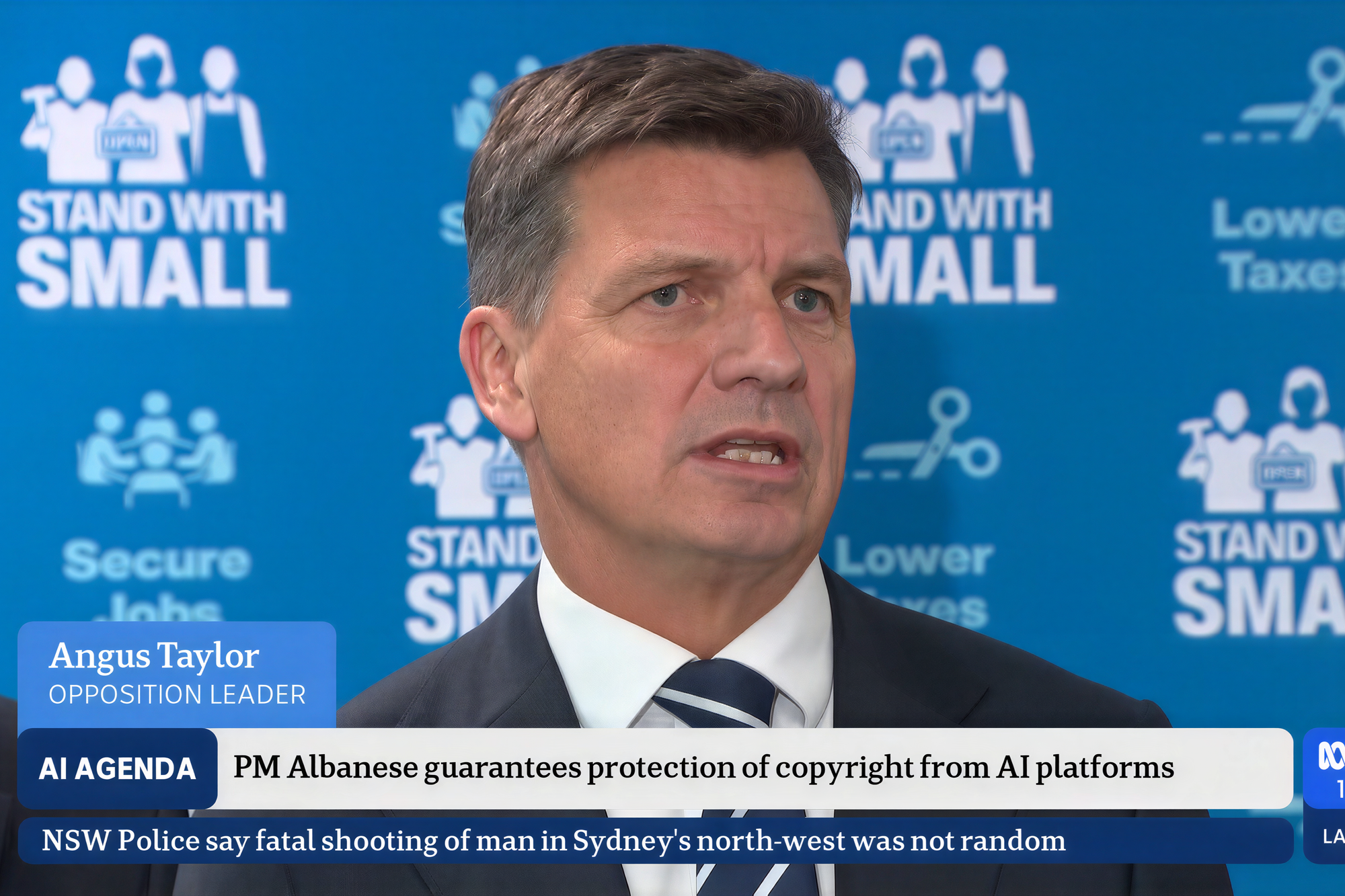
Opposition Leader Angus Taylor got in before the speech was delivered.
"What's very clear is his first reaction is just create more bureaucracy," Mr Taylor said. "The first reaction should be to make sure Australia is secure, getting access to the very best AI for cyber defence."
Afterwards he was sharper.
"There are threats, but there are also opportunities to create jobs, to drive rising incomes, to secure our country," he said. "But it seems that the only jobs the government is going to create with AI in this country is in the Prime Minister's office."
Greens senator David Shoebridge went at the same gap from the other side.
"What the Prime Minister has offered today is a single door in his office, no additional statutory powers, no additional resources, but a door that the big tech industry can knock on to get what they want," he said. "That is not going to deliver the protections Australians have been asking for."
The pressure has a number on it.
Anthropic has told the government its proposed $21.6 billion investment is contingent on clarity of copyright settings. Chief executive Dario Amodei met Treasurer Jim Chalmers in April to discuss barriers to AI training in Australia, particularly copyright reform. The company wants 1.4 gigawatts of local data centre power to make Australia its second training hub outside the United States.
It responded to the speech within hours.
"We respect the process articulated by the Prime Minister today for establishing Australia's AI framework and take seriously Anthropic's responsibility to meet the terms set out by the Australian Government for AI developers," an Anthropic spokesperson said.
A statement about process. It does not mention copyright.
Treasury's briefing note was less accommodating. Anthropic argues training is fair use; Australian officials wrote the matter is not settled, noting an estimated 81 AI-copyright lawsuits before US courts as of February. Anthropic's own case ended in a $1.5 billion settlement with authors over pirated books used in training.
In late June, independent ACT senator David Pocock was tipped off about an industry push for a copyright carve-out in exchange for at least $50 billion in data centre investment and a creators' fund worth around $350 million a year. He called it the ultimate dirty deal. The government called his account inaccurate.
Ed Husic, the industry minister who was building a dedicated AI act before he was dumped from the frontbench in 2025, called the social licence approach "sadly doomed to failure".
"We tried self-regulation for a couple of decades, found out that it didn't work," he said.
Theft was the Prime Minister's word.
The law that would make it one is due next year.