WATCH: AI companies are buying rare books in bulk, cutting the spines off and shredding them, and a US judge has ruled it legal
Booksellers in four countries report bulk orders with no pattern beyond an ISBN, and the broker marketing the service warned clients the optics were a problem.
Somewhere in a warehouse, a hydraulic cutter is taking the spine off a book so the loose pages can be fed through a scanner. Once the text is captured the paper goes to recycling.
The pages become training data. Books are dense, edited, human-written prose, and a model like ChatGPT or Anthropic’s Claude needs enormous volumes of it to learn how to write.
The process is called destructive scanning. It is faster and cheaper than the method libraries and the Internet Archive use, which keeps the book intact. And a US federal judge has ruled that if you own the book, you are entitled to do it.
That ruling is now the foundation of a supply chain running from used-book warehouses into AI training data.
404 Media reported on July 21 that ISBNdb, which maintains a database of more than 111 million titles, had begun marketing bulk physical book acquisition to AI labs — 1,000 to one million books per order, sourced from libraries, retailers and estate sales.
The pitch was that print published before the large language model era is structurally guaranteed to be free of AI-generated contamination. The open internet is now saturated with machine-written text, and models trained on machine output degrade.
The site also told prospective clients that the optics problem is real, and that “AI company destroys two million books” is not a headline that generates sympathy. It offered a strict non-disclosure agreement on every engagement.
Those pages have been taken down. ISBNdb now says it never launched the service, never bought, scanned or destroyed a book, does not train AI models and never has, and that the page was exploring demand for something it never built.
The demand appears to exist regardless.
One anonymous bookseller told 404 Media weekly sales went from under 20 books to several hundred from April, with orders showing no pattern by author or subject beyond carrying ISBNs. Dealers in the Netherlands, Germany and Switzerland have reported the same. A Dutch bookseller assumed a request for 3,000 copies was phishing.
“It benefits me financially as well as by clearing out old inventory that is otherwise unlikely to sell,” the anonymous seller said. “On the other hand, I don’t like the end-use, and I don’t like that uncommon books are being pulped.”
Elon Musk has told his own AI team to preserve rare books and scan them the hard way instead.
The reason any of this is legal comes from the case The Glass reported last month.
Anthropic paid $1.5 billion in July — the largest copyright settlement in US history — for downloading more than seven million pirated books from LibGen and the Pirate Library Mirror. About $3,000 a book across roughly 482,000 works. Ninety-one per cent of the authors have now claimed their share.
But Judge William Alsup’s ruling in June 2025 split three ways, and only one part cost Anthropic anything.
Training a model on books is transformative fair use. Piracy is not. And destructively scanning a book you legally own is fair use too — because the digital file replaces the print copy rather than adding to it. Keep the book and you have two copies. Shred it and you have one.
The shredding was free.
Court filings unsealed in the same case describe how Anthropic did it. The program was called Project Panama and began in early 2024, after the company worked out how exposed its piracy had left it.
An internal planning document put the goal plainly: “Project Panama is our effort to destructively scan all the books in the world.” The same document explained the codename — “we don’t want it to be known that we are working on this.”
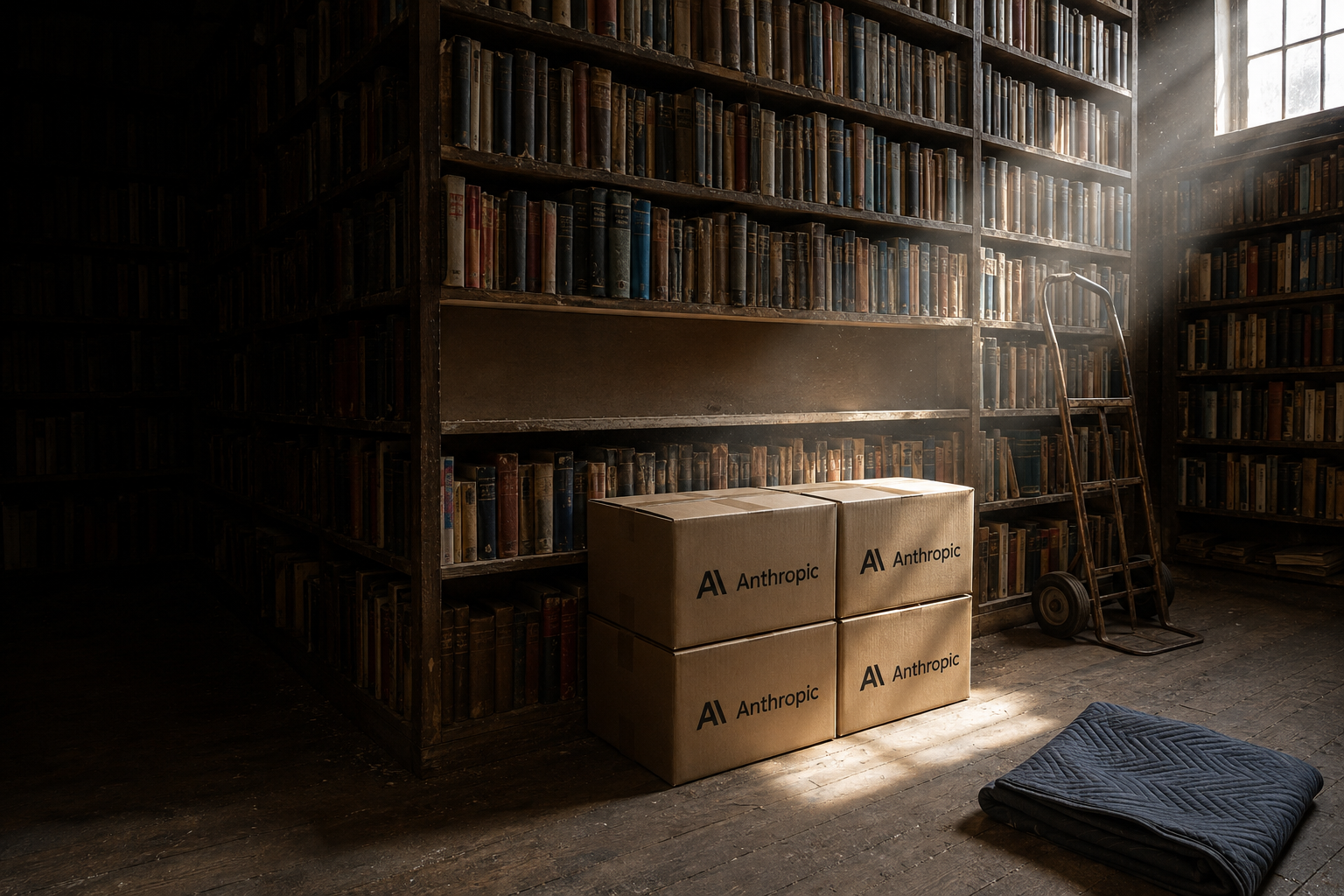
Anthropic hired Tom Turvey, who had run partnerships for Google Books, in February 2024. It bought used stock in bulk, including from Better World Books and World of Books. One vendor proposal covered 500,000 to two million books over six months. The program cost tens of millions of dollars.
Anthropic says none of its data acquisition programs buy and destroy rare or antiquarian books.
None of this is illegal in Australia, and nothing Anthony Albanese has promised would change it.
The Prime Minister said in Sydney last month that Australian writers, musicians, artists and journalists must retain ownership and control of their work, and that anything less is theft. Legislation is due early next year, subject to the agreement of every state and territory.
That is about permission to train. The first-sale doctrine governs what you may do with a book you have already bought, and buying a book and destroying it has never required anyone’s permission.