How vanity built Australia's newest underworld economy
A vanity trend mutated into a multi-million dollar underworld economy — running on the same supply chain as Australia's drug syndicates.
I first heard of peptides in the mid 2010s, right around the time commercial solariums were banned across Australia.
A friend who frequented them showed me a tiny glass vial — a clear fluid that allegedly promised the same deep tan without the UV bed.
To me, it sounded like dangerous pseudoscience.
I disregarded it, assuming it was a niche gym fad that would fade away.
I didn't think about it again until recently, when the digital landscape shifted.
Suddenly, my feeds were flooded with the extreme vanity of "looksmaxxing" trends, podcast parrot Joe Rogan, worm-brained RFK Jr giving biohacking a mainstream tick of approval, and the global explosion of Ozempic.
It created the perfect storm: a cultural obsession with unrealistic beauty standards meeting human nature's timeless habit of cutting corners — except it's cutting across a three-lane highway in heavy traffic to avoid a missed exit.
What that friend was almost certainly showing me was melanotan — a synthetic tanning peptide cooked up in the 1980s, abandoned in clinical trials over safety concerns, never approved for human use anywhere on earth, and already circulating through gym networks and tanning salons by the mid-2000s.
For years, that was the peptide scene: a niche subculture of bodybuilders and committed tanners who knew what they were getting into, or thought they did.
Then Ozempic blew the doors off.
A peptide could genuinely transform a body — and the demand for that transformation turned out to be bottomless, the supply was not, and the price was prohibitive.
People wanted the result without the prescription, the wait, or the cost.
The grey market didn't hesitate.
By late 2025, the whole thing had collided with looksmaxxing on TikTok — influencers linking followers directly to China-based grey-market peptide vendors in their bios.
The on-chain grey-market peptide economy crossed a $100 million annual run rate in 2026, according to blockchain analytics firm Chainalysis.
What started as a vanity subculture has mutated into a multi-billion dollar global demand signal — and Australia is not watching from the sidelines.
Raw peptide powders are imported cheaply from Chinese factories, arriving labelled "for research use only" — a legal fig leaf that everyone involved understands is fiction — or mislabelled as industrial chemicals to dodge border security.
Once inside Australia, the powder is reconstituted into injectable vials — a manufacturing process with striking parallels to cooking methamphetamine.
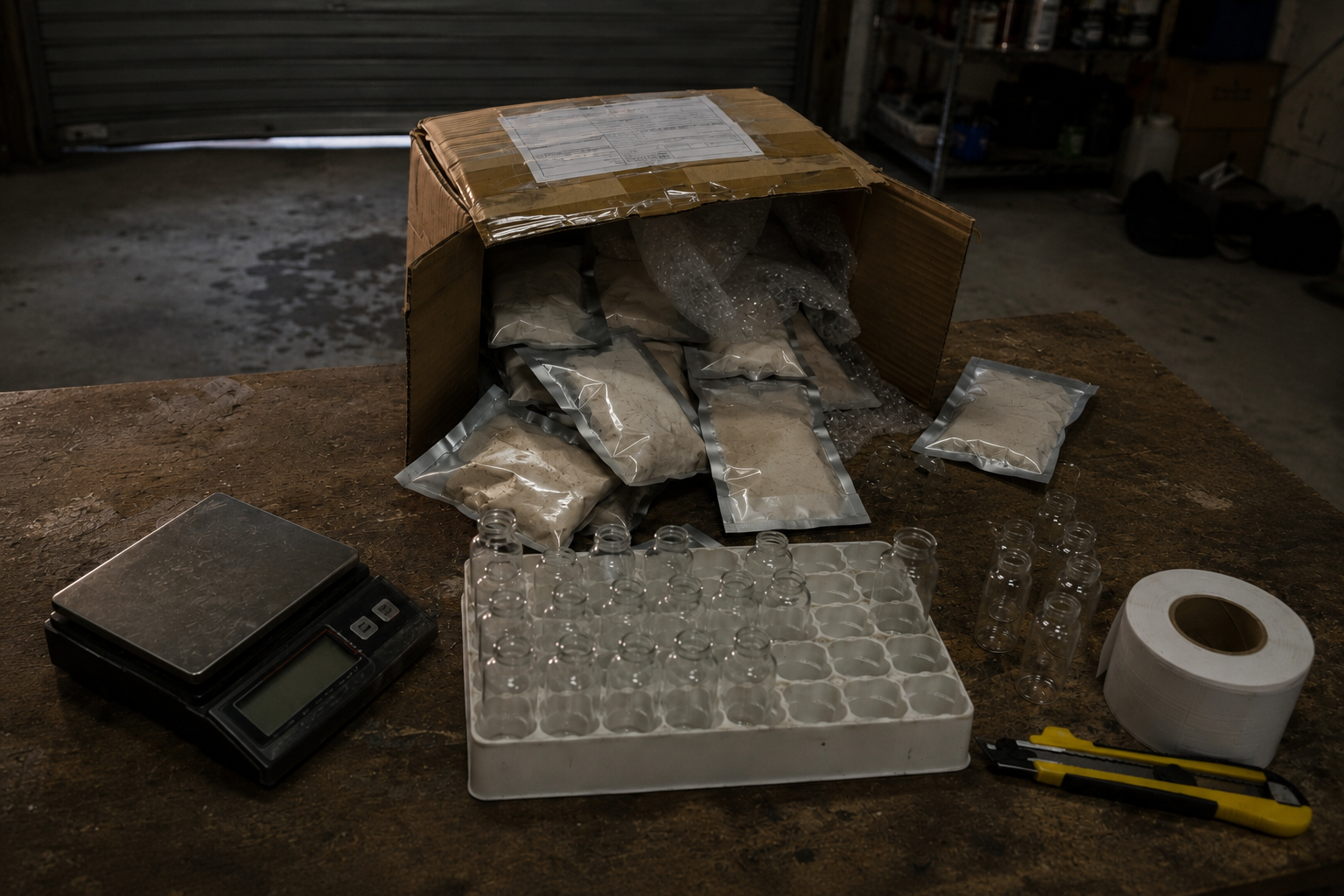
Both require a basic chemistry setup in domestic premises that were never designed for pharmaceutical manufacturing.
Both carry the same fundamental risk: no quality control, no sterility, no oversight.
The parallel runs deeper than method.
Chainalysis traced Chinese chemical manufacturers who literally pivoted from supplying fentanyl precursors to drug cartels directly into grey-market peptide sales — one firm using the same phone number it had used with its cartel clients.
Both substances will make you lose weight.
Except one of them won't leave you frantically dismantling household appliances at 3am, and it might actually improve your skin.
The reality of this pipeline was laid bare twice in three months on Melbourne's streets.
In late March, the ABF, TGA and Victoria Police smashed an alleged import syndicate across Melbourne's west — more than 10,000 vials and 600 tablets of illicit steroids and peptides worth in excess of $2 million, gone.
Then on June 4, Victoria Police's Eastern Region Crime Squad executed 12 simultaneous warrants at homes, businesses and factories stretching from the CBD to the southeastern and northern suburbs.
Eight arrests.
At a single Narre Warren North property, police seized a large quantity of peptides and almost 20 firearms, including handguns.
Not wellness enthusiasts. An armed, multi-million dollar trafficking operation — the peptides sitting right alongside the cocaine and the handguns.

But the danger is not just the firepower backing the trade.
It's what is inside the glass.
Peptide testing startup Finnrick Analytics has found that roughly 30 per cent of the products it analyses are mislabelled, incorrectly dosed, or contaminated.
A vial might be completely underdosed.
It might be dangerously overdosed.
It might contain a completely different compound altogether.
The consumer scrolling TikTok, looking for a quick fix, has absolutely no idea.
In the pursuit of the perfect body, everyday Australians are injecting unverified, unsterile chemicals into their skin — and directly funding caches of illegal firearms and organised crime networks on our streets.