Fox made a quarter of a billion dollars from the water breaks at Trump’s World Cup, and now FIFA wants to sell the whole thing
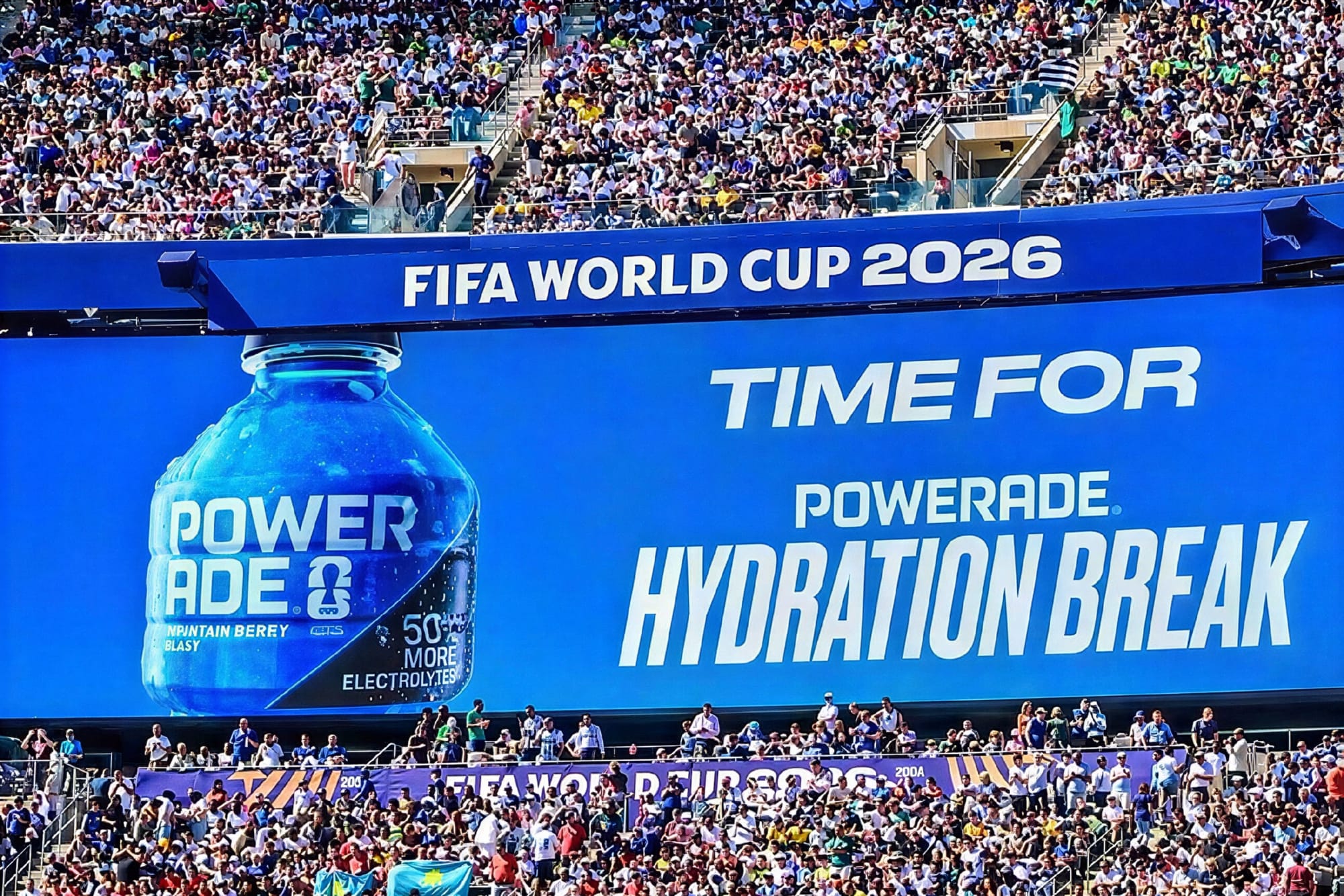
The stoppages were introduced for player welfare and became 832 advertising slots, at a tournament where the US president had a red card reversed.
Football had one commercial break. Half-time.
For as long as the game has been televised that was the constraint every broadcaster worked around — 90 minutes of continuous play with a single window in the middle that could be sold. Then FIFA took the World Cup to America and fixed it.
Last December, FIFA announced every match at the 2026 tournament would carry two mandatory three-minute hydration breaks, at roughly the 22nd minute of each half. Not weather-dependent. Not stadium-dependent. Every game across Canada, Mexico and the United States, whatever the roof, the temperature or the kick-off time.
The reason given was player welfare, and there was precedent — FIFA had used cooling breaks before, and had dropped its mandatory threshold from a wet-bulb temperature of 89 degrees Fahrenheit to 82 after players complained at the 2025 Club World Cup.
What it also did was cut the match into quarters.
FIFA then confirmed broadcasters could sell advertising inside the stoppages, and set the terms: a 20-second buffer at the start, a 30-second buffer at the end, back on air 30 seconds before the restart. What fits in the middle is four 30-second commercials. Eight a match. Across 104 matches, 832 slots that did not exist at any previous World Cup.
Fox, holding the US English-language rights, sold all of them.
The network paid a reported $US485 million for those rights, cheap for a tournament played in American time zones for the first time since 1994. Group-stage spots inside the breaks went for $US200,000 to $US300,000. Matches involving the United States went for about $US750,000. Later rounds ran between $US1 million and $US2 million, and a single 30-second unit in the Spain–Argentina final cleared $US1 million.
At a conservative $US300,000 average, the break inventory alone is worth about $US249.6 million. At $US400,000 it is $US332.8 million. The Hollywood Reporter put the range at $US250 million to $US600 million — more than half the rights fee, recovered from pauses sold as heat mitigation. Across every territory holding rights, estimates put the global figure near $US1 billion.
A Murdoch network made hundreds of millions of dollars because the planet got hotter.
The whole tournament ran on that logic — American rhythms, American money, and an American president who treated it as his. Donald Trump lobbied Gianni Infantino to lift the red card against US striker Folarin Balogun before the last 16, in what the Guardian reported was three separate calls. FIFA suspended the ban under Article 27 of its disciplinary code, converting it to a $40,000 fine and a conditional one-year suspension. Belgium’s appeal to have it restored was ruled inadmissible.
Trump took a victory lap on Truth Social, thanking FIFA for “reversing a great injustice”. Asked about it by reporters, he said of the tackle: “that wasn’t even an infraction.”
England manager Thomas Tuchel asked the obvious question. “Where does this start and where does this end?” he said.
Two weeks later Trump stood beside Infantino to hand Spain the trophy.
Telemundo, holding the Spanish-language rights, was the one broadcaster that said no. It stayed with the live feed through every hydration break and took the goodwill instead — enough that English-speaking viewers began switching to a broadcast in a language they did not understand.
They had cause. Fox cut to a full-screen commercial during the very first hydration break of the opener in Mexico City, then returned from the second-half break late, after the ball was already in play. Viewers missed about 10 seconds of live World Cup football. In the stadiums, crowds booed the stoppage at nearly every match.
It changed nothing, because the numbers were never going to permit it. Guideline data puts total US advertising revenue across Fox and Telemundo at $US1.19 billion — 2.7 times the $US441.9 million spent on Qatar, a 170 per cent rise driven by the time zones, the 48-team field and the breaks. Streaming alone took $US166.2 million, up from $US17.7 million.
Dennis Deninger, author of Live Sports Media, told BBC Sport the change is permanent. “There is never any going back,” he said. No rights holder has ever volunteered to earn less.
Which is the part that matters now.
The company FIFA is asking its 211 member associations to approve by September 19 — FIFA Forward Enterprise, valued at about $US20 billion, with up to 20 per cent going to private investors underwritten by Joshua Kushner’s Thrive Capital — bundles broadcast rights, sponsorship, ticketing and licensing into a single sellable asset.
That asset spent June and July proving it can invent new advertising inventory in the middle of a match and sell it for a billion dollars.
The breaks were introduced for the players. They were priced for the buyers.